Concrete Singh

Call us on
020 8702 9111
Speedy Delivery
Call us on
020 8702 9111

How Waterproof Concrete Protects Structures from Moisture

What actually destroys concrete is rarely impact or load; it is water working quietly over time, seeping into pores, freezing, expanding, and slowly weakening the structure from within. From basements that never quite stay dry to external slabs that crack long before their time, moisture is the silent factor behind many premature concrete failures.

This is why contractors working with Concrete Singh across London and the UK increasingly specify waterproof concrete for projects where moisture exposure is unavoidable and failure is not an option.

Get ready as we break down how waterproof concrete works at a material level, where it performs best, and what to consider before specifying it for your next project. Let’s get started.

Why Moisture Is a Serious Threat to Concrete Structures

Concrete is strong in compression, but it is not naturally watertight. Standard concrete contains microscopic pores that allow water to pass through over time, especially under pressure.

If you aren’t proactive, unchecked moisture can lead to:

  • Cracking caused by freeze–thaw cycles
  • Corrosion of steel reinforcement
  • Damp penetration into internal spaces
  • Efflorescence and surface staining
  • Reduced structural lifespan

Once moisture-related damage begins, repairs are often invasive and expensive. That’s why preventing water ingress at the concrete stage is far more effective than treating symptoms later.

What Is Waterproof Concrete?

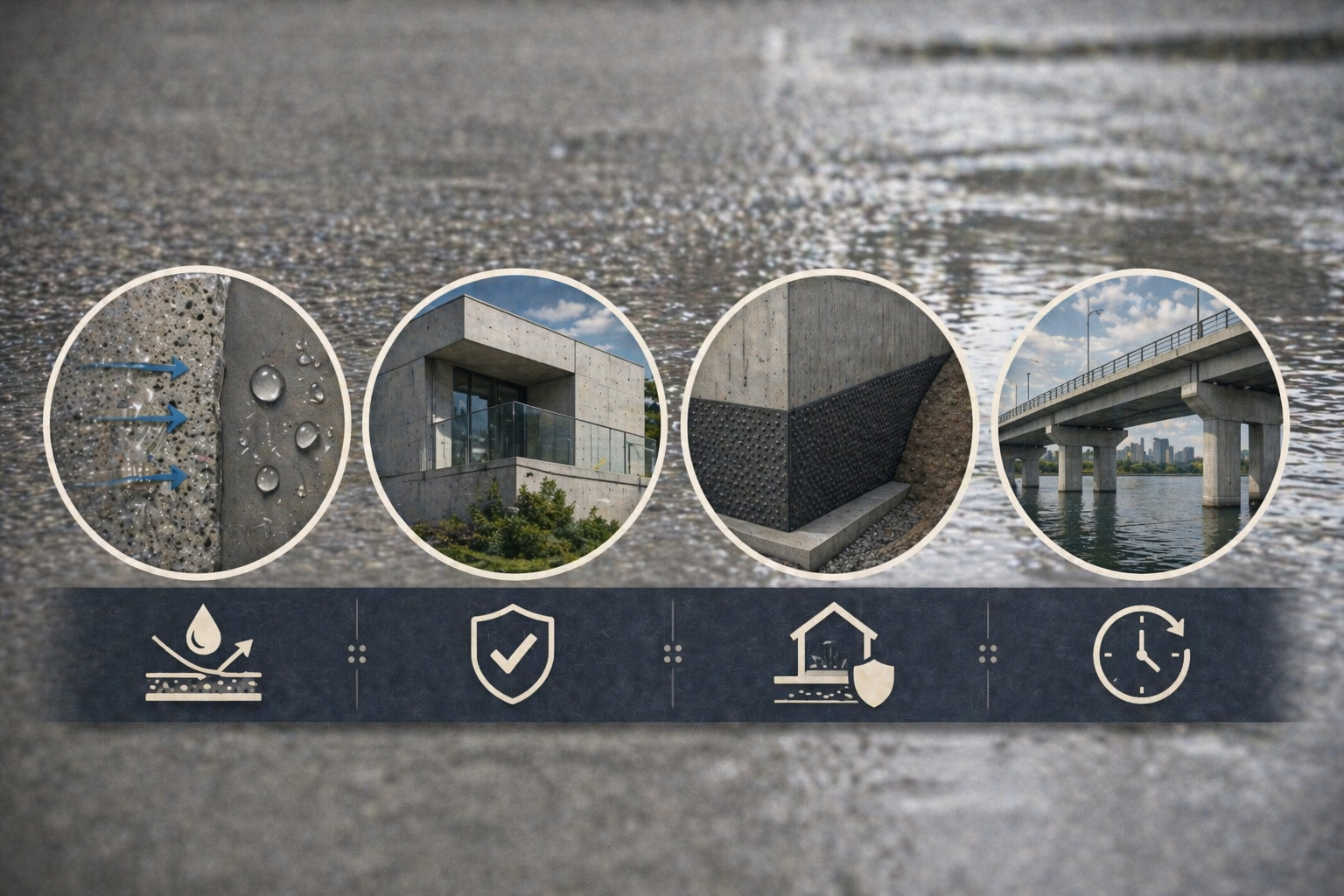
Waterproof concrete is engineered to resist water penetration throughout the concrete mass, not just on the surface. Instead of relying solely on membranes or coatings, the concrete itself is modified to limit water movement.

The best way to achieve this is through any of the following methods:

  • Reduced water-to-cement ratios
  • Densely packed aggregates
  • Special admixtures that block or react with water pathways

Unlike surface sealers, concrete waterproofing is non-negotiatable and remains effective even if the surface is damaged, making it ideal for structural applications.

How Waterproof Concrete Works in Practice

The performance of waterproof concrete comes down to its internal structure. When properly designed and mixed, it limits the size and connectivity of pores that water would otherwise travel through.

Key mechanisms include:

  • Pore blocking: Admixtures react with moisture to form insoluble crystals that block capillaries
  • Increased density: Tighter particle packing reduces permeability
  • Crack control: Improved mix performance helps limit shrinkage-related cracking

This integrated protection is why waterproof concrete is often specified for below-ground and water-exposed structures.

Common Applications of Waterproof Concrete

Waterproof concrete is used wherever long-term moisture exposure is expected or where internal dryness is critical.

Typical applications include:

  • Basements and foundations
  • Retaining walls
  • Underground car parks
  • Water tanks and drainage structures
  • Ground-bearing slabs
  • Commercial and industrial floors

In urban environments like London, where high water tables and restricted drainage are common, waterproof concrete offers added peace of mind.

Waterproof Concrete vs Surface Waterproofing

Many projects rely on membranes or coatings applied after the concrete has cured. While these systems can be effective, they have limitations.

Surface waterproofing:

  • Can be punctured or damaged
  • Requires perfect installation
  • Often needs ongoing maintenance

Waterproof concrete:

  • Protects the full concrete section
  • Works even if the surface is compromised
  • Reduces reliance on external systems

In many cases, combining waterproof concrete with external waterproofing delivers the highest level of protection.

Why Mix Design and Supply Quality Matters at Concrete Singh

Waterproof performance depends heavily on accurate batching and consistent quality. Incorrect water content or poor mixing can compromise the entire system.

At Concrete Singh, we add real value by supplying waterproof concrete mixes across London, Barking, Chingford, Enfield, Essex, and throughout the UK. We ensure that the concrete delivered to site performs exactly as specified, not just on paper but under real site conditions.

Beyond high-quality mixes, we offer same-day delivery, flexible batching options, and on-site support to help projects run smoothly, on time, and without compromise.

Conclusion

Waterproof concrete plays a massive role in protecting structures from moisture-related damage, extending service life and reducing long-term maintenance. For this reason, it is important you address water resistance at the mix design stage so as to provide protection that surface treatments alone cannot match.

If your project involves foundations, basements, or moisture-sensitive structures, Concrete Singh can advise on and supply waterproof concrete solutions tailored to site conditions anywhere across the UK. Don’t hesitate to contact us today for more information. 

Leave a Reply

Your email address will not be published. Required fields are marked *

Concrete Singh
Privacy Overview

This website uses cookies so that we can provide you with the best user experience possible. Cookie information is stored in your browser and performs functions such as recognising you when you return to our website and helping our team to understand which sections of the website you find most interesting and useful.