Concrete Singh

Call us on
020 8702 9111
Speedy Delivery
Call us on
020 8702 9111

Why Is My Concrete Surface Flaking or Peeling?

A concrete surface that begins to flake, peel, or shed thin layers is an eyesore and a sign that something went wrong either during the mix, the pour, or the finishing process. The damage is known as spalling or scaling, and it is one of the most common surface defects reported on driveways, paths, and concrete floors across the UK.

The good news is that most causes are identifiable and many can be prevented entirely. As major suppliers of quality ready-mix concrete across London, Essex, Brentwood, Enfield, Southgate, and other parts of the UK, we regularly see the consequences of poor mix quality and incorrect finishing. 

This guide explains exactly why it happens and what can be done about it. Let’s get right into it.

What Is Concrete Spalling?

Spalling refers to the breaking away of the concrete surface layer, typically in thin flakes or chips. It can affect a small isolated area or spread progressively across an entire slab. In its early stages, it appears as surface pitting or roughness. Left unaddressed, it exposes the aggregate beneath and weakens the structural integrity of the slab over time.

It is important to distinguish spalling from general surface wear. Light scuffing or minor abrasion from foot traffic is normal over many years. Spalling, by contrast, involves actual material loss from the surface layer and tends to accelerate once it begins.

The Most Common Causes

Flaking and peeling rarely happen for a single reason. In most cases, two or three contributing factors combine to produce the result. Understanding them individually makes it easier to identify what went wrong and how to prevent it in future work. 

Here are some common reasons this occurs: 

Excess Water in the Mix

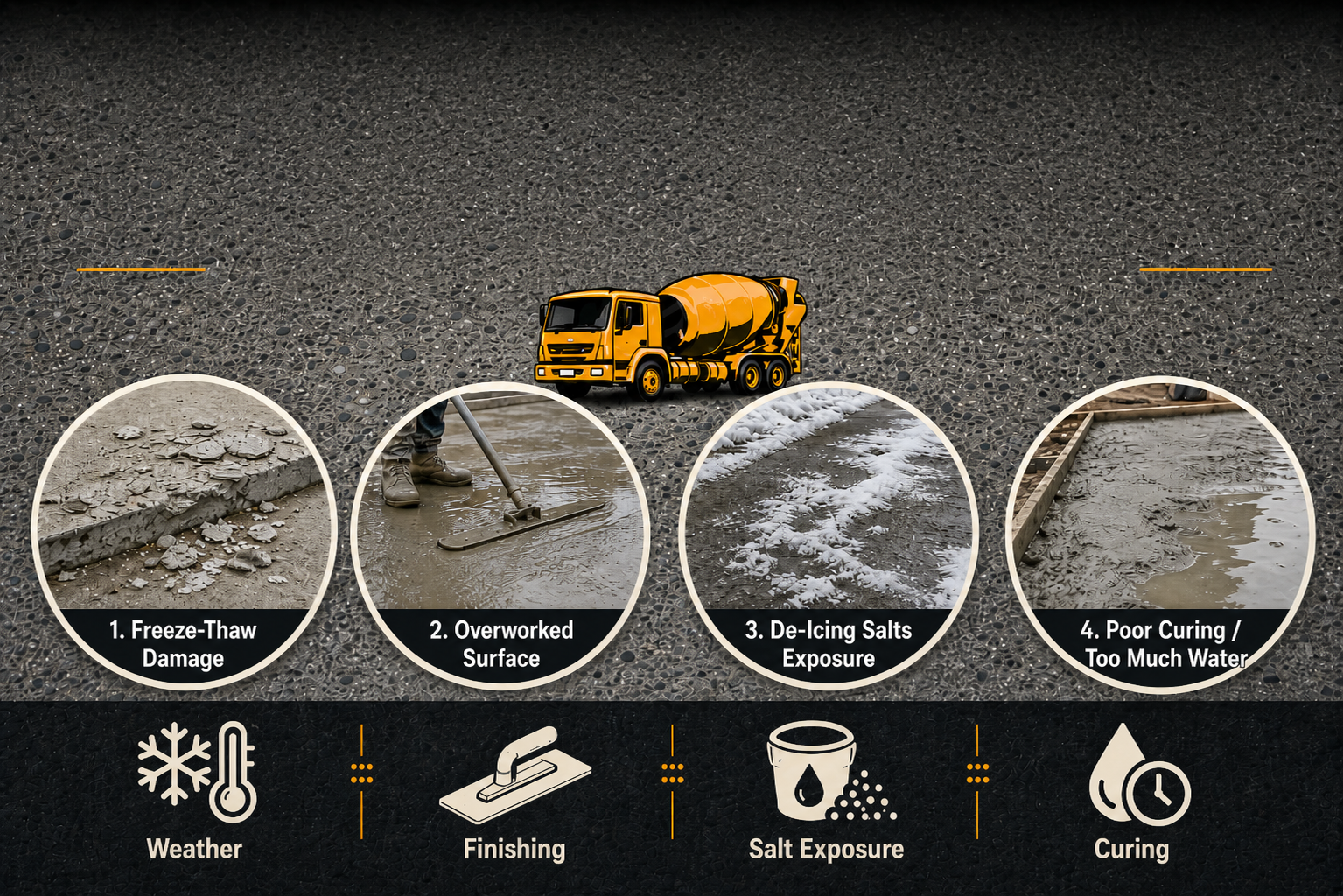
Adding too much water to a concrete mix weakens the cement paste and increases the water-to-cement ratio beyond the design specification. The result is a surface layer that is porous, soft, and prone to scaling under freeze-thaw cycles or traffic load. 

This is one of the most common on-site errors and one of the easiest to avoid by using correctly batched ready-mix concrete. Although having a waterproofed concrete in place is often the best option and would help set things right. 

Freeze-Thaw Cycling

Water that penetrates the surface of concrete expands when it freezes. Repeated freeze-thaw cycles, which are often common in UK winters, create internal pressure that forces the surface layer apart from beneath. Concrete that was mixed with excess water, finished too early, or inadequately cured is particularly vulnerable to this type of damage.

Premature Finishing

Finishing the surface of concrete while the bleed water is still rising is a critical mistake. Bleed water is the excess moisture that migrates to the surface during the early stages of setting. If a finisher works this water back into the surface by trowelling too early, it significantly weakens the top layer and creates ideal conditions for scaling.

Use of De-icing Salts

Rock salt and chemical de-icers are widely used on driveways in winter. These compounds accelerate the freeze-thaw cycle at the surface and draw moisture into the concrete, dramatically increasing the risk of spalling. New concrete is especially vulnerable in its first winter and should not have de-icers applied within the first 12 months.

Underspecified Mix Grade

Concrete that is too weak for its application will deteriorate faster under load and environmental exposure. A driveway specified at C20 when C25 or C30 was required will show surface degradation far sooner than a correctly graded mix. Choosing the right grade from the outset is the most effective long-term protection.

Inadequate Curing

Curing is the process by which concrete develops its full strength through continued hydration. If curing is cut short, by allowing the surface to dry too quickly in hot or windy conditions, or by opening the slab to traffic too soon, the surface layer never reaches its design strength and remains susceptible to damage.

Can Spalling Be Repaired?

Minor surface spalling can be repaired using a concrete resurfacer or bonding agent applied over the affected area. For the repair to hold, the existing surface must be structurally sound, clean, and properly prepared. Repairs applied over weak, contaminated, or actively deteriorating concrete will not last.

Where spalling is widespread or deep, full resurfacing or slab replacement is the more practical solution. A patch repair on a fundamentally compromised slab is rarely cost-effective in the long run.

How to Prevent It From the Start

The most reliable way to avoid surface spalling is to get the fundamentals right before the concrete is poured. These are the steps that matter most:

  1. Use correctly batched ready-mix concrete with the appropriate grade and water-to-cement ratio for your application.
  2. Do not add water to the mix on site. Even small additions increase porosity and reduce surface strength significantly.
  3. Allow bleed water to evaporate fully before any finishing work begins.
  4. Cure the concrete properly. Keep it moist and protected for at least 7 days after the pour.
  5. Seal the finished surface once curing is complete to reduce water and salt ingress.
  6. Avoid de-icing salts, particularly during the first winter after laying.

Supply Your Project with Concrete Singh

At Concrete Singh, we supply premium ready-mix concrete with correctly controlled mix designs to domestic and commercial customers across London, Brentwood, Enfield, Edmonton, Southgate, Essex, Kent, and throughout the UK. Our batching process eliminates the on-site mixing errors that lead to surface defects like spalling and scaling.

With same-day delivery, flexible batching, and technical support on mix selection, we help ensure your concrete performs as expected from day one. Reach out to Concrete Singh today for quality ready-mix concrete delivered to your site.

FAQs

Why is my new concrete driveway already flaking?

New concrete that flakes quickly was likely finished while bleed water was still present, mixed with too much water, or exposed to frost before curing was complete. Concrete Singh supplies correctly batched ready-mix that eliminates the most common mix-related causes.

Can I fix spalling concrete myself?

Minor spalling over a structurally sound slab can be repaired with a resurfacing product. Widespread or deep spalling usually requires professional assessment. For future projects, using quality ready-mix from Concrete Singh helps prevent the problem from arising.

Does sealing concrete prevent flaking?

Yes. A quality concrete sealer applied after curing reduces water and salt ingress. It is one of the most cost-effective ways to extend the life of any concrete surface. Concrete Singh can advise on the right timing for sealing after your pour.

How long should I wait before using a new concrete surface?

At least 24 to 48 hours for foot traffic and 28 days before vehicles. Premature loading is a leading cause of surface damage on new slabs. Concrete Singh provides guidance on curing timelines for every project we supply.

Does the type of concrete mix affect spalling?

Significantly. A weak or poorly batched mix is far more susceptible to surface deterioration. Specifying the correct grade and sourcing from a reliable supplier like Concrete Singh is the most effective long-term protection.

Leave a Reply

Your email address will not be published. Required fields are marked *

Concrete Singh

Privacy Overview

This website uses cookies so that we can provide you with the best user experience possible. Cookie information is stored in your browser and performs functions such as recognising you when you return to our website and helping our team to understand which sections of the website you find most interesting and useful.