Concrete Singh

Call us on
020 8702 9111
Speedy Delivery
Call us on
020 8702 9111

Can I Pour Self leveling Concrete Over Existing Concrete?

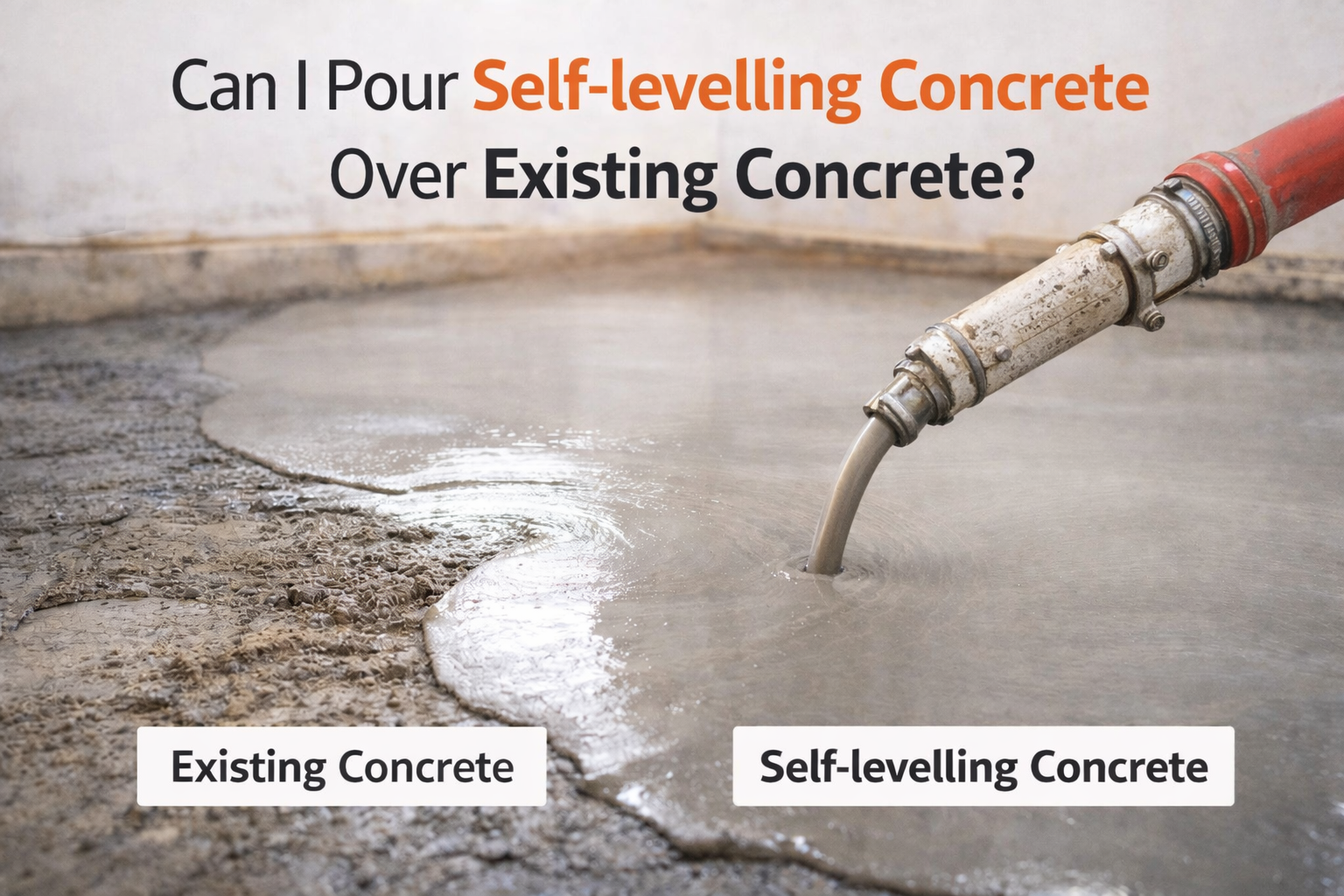
When an existing concrete floor is uneven, cracked, or poorly finished, the question often arises whether it needs to be broken out entirely or if it can be corrected on top. In many domestic and commercial settings, pouring self-leveling concrete over existing concrete is a practical and cost-effective solution when the base is still structurally sound.

But you need to understand when it works, what preparation is required, and how a levelling compound should be applied to achieve a durable, flat finish. With Concrete Singh, you can be confident that you’re getting premium concrete and expert floor solutions across London and the UK. 

Keep reading to discover whether you can pour self-leveling concrete over your existing floor, and how to do it right.

What Is a Levelling Compound?

A levelling compound is a cement-based or polymer-modified material that flows easily and settles into low spots under its own weight. The important things to note include:

  • Material type: Cement-based or polymer-modified. Best for allowing flow and self-settling into low spots.
  • Minimal finishing required: Unlike traditional concrete, it does not need extensive trowelling to achieve a flat surface..
  • Application thickness: Typically 2 mm to 30 mm in a single pour, depending on the product.
  • Purpose: Ideal for correcting minor slopes, dips, and surface imperfections without adding excessive weight.

When To Use Self-Leveling Concrete

Self-leveling products are designed to correct surface irregularities, not to fix structural defects. The existing slab must be stable, load-bearing, and free from active movement. If the concrete is cracked due to settlement or subsidence, leveling alone will not solve the problem.

A levelling compound can typically be applied when:

  • The existing concrete is structurally sound
  • Surface unevenness is within manufacturer limits
  • Cracks are non-moving and properly repaired
  • Moisture levels are controlled

When these conditions are met, self-leveling concrete provides a smooth, uniform surface suitable for tiles, vinyl, resin, or direct use in light-duty areas.

Preparing Existing Concrete Correctly

Preparation determines whether a leveling application succeeds or fails. Even the best product will debond if the surface is dirty or poorly treated. Before applying a levelling compound, the existing concrete must be prepared thoroughly.

Here’s are the key steps needed in this process include:

  • Step 1: Cleaning the surface

Remove dust, grease, paint, curing agents, and adhesives. Mechanical grinding is often recommended for best results.

  • Step 2: Repairing cracks and holes

Fill static cracks and voids using appropriate repair mortars and allow them to cure fully.

  • Step 3: Priming the slab

Apply the manufacturer-approved primer to control suction and improve adhesion.

  • Step 4: Checking moisture levels

Excess moisture can cause debonding or curing failure, especially in enclosed spaces. 

Comparison: Self-Leveling vs Traditional Concrete Overlay

FeatureLevelling CompoundTraditional Concrete
Typical thickness2–30 mm50 mm and above
Flow characteristicsSelf-flowingRequires manual finishing
Drying timeFast (hours)Slow (days)
Best use caseSurface correctionStructural builds

Why Use Concrete Singh?

At Concrete Singh, we support leveling projects by supplying consistent, high-quality concrete and practical guidance that helps ensure each stage is carried out correctly.  Whether the project involves preparing a base for a levelling compound or supporting larger floor works, we deliver reliable materials and dependable service across London, Brent Cross, Kent, Essex and the UK.

Final Verdict

So, to answer the question: Yes, you can pour self-leveling concrete over existing concrete, provided the base is sound and properly prepared. A high-quality levelling compound offers a fast, efficient way to correct uneven surfaces without removing the original slab. When preparation, product selection, and application are handled correctly, the result is usually a smooth, durable finish ready for use.

If you are planning a leveling project and need advice on preparation or concrete supply, contact Concrete Singh with your site details. We deliver precision, reliability, and quality without compromise.

Leave a Reply

Your email address will not be published. Required fields are marked *

Concrete Singh

Privacy Overview

This website uses cookies so that we can provide you with the best user experience possible. Cookie information is stored in your browser and performs functions such as recognising you when you return to our website and helping our team to understand which sections of the website you find most interesting and useful.